Buying your first adventure motorcycle is exciting — and completely overwhelming. Every forum post recommends a different bike, every YouTube review contradicts the last one, and the price range spans from $3,000 used to $25,000 new. Here's how to cut through the noise and pick the right bike for you.

Step 1: Be Honest About How You'll Ride
This is the single most important step, and the one most new riders skip. Adventure bikes exist on a spectrum from "tall touring bike" to "street-legal dirt bike." Where you fall determines everything.
Ask yourself these questions:
- What percentage of my riding will be off-road? (Be honest — 5% is a valid answer)
- Will I ride two-up with a passenger?
- How far is my daily commute?
- Am I doing mostly weekend trips or multi-week expeditions?
- What's my inseam? (Seat height matters more than you think)
Step 2: Choose Your Weight Class
Adventure bikes fall into three weight categories, and this is the most consequential decision you'll make.
Lightweight (under 400 lbs) — The Off-Road Specialists
Best for: Riders who want genuine off-road capability. These bikes can handle technical single-track, deep sand, and rocky terrain. They're easy to pick up when dropped and nimble in tight situations.
Examples: Yamaha Ténéré 700, Honda CRF450L, Suzuki DR650, KTM 390 Adventure
Trade-offs: Less wind protection, smaller fuel tanks, less comfortable on long highway stretches, limited passenger accommodations.

Middleweight (400–550 lbs) — The Sweet Spot
Best for: Riders who want the best of both worlds. Capable off-road (with proper tires and skills), comfortable enough for long highway days, and not so heavy that dropping the bike is a catastrophe.
Examples: BMW F 900 GS, Triumph Tiger 900, KTM 890 Adventure R, Aprilia Tuareg 660
Trade-offs: More expensive than lightweights, heavier in technical terrain, some models lean more street than dirt.
Heavyweight (550+ lbs) — The Grand Tourers
Best for: Long-distance touring, two-up riding, and riders who prioritize comfort and technology. These are incredible road bikes that can handle gravel roads and easy fire roads.
Examples: BMW R 1300 GS, Honda Africa Twin, Ducati Multistrada V4, KTM 1290 Super Adventure
Trade-offs: Very heavy off-road, expensive to buy and maintain, intimidating for new riders, expensive crash damage.
Step 3: New vs. Used
For your first adventure bike, strongly consider buying used. You're going to drop it. You're going to scratch it. You're going to discover what you actually want after 5,000 miles and potentially want something different.
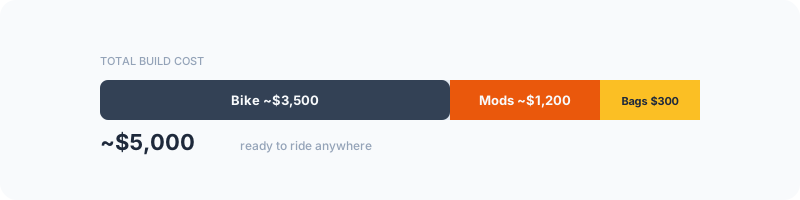
A 2–3 year old bike with 10,000–20,000 miles saves you 30–40% off new pricing and has already absorbed the steepest depreciation. Plus, it'll likely come with aftermarket accessories (crash bars, skid plate, luggage) that the first owner paid for.
Step 4: Essential Features vs. Nice-to-Haves
Essential:
- ABS (non-negotiable for safety)
- Comfortable ergonomics for your body
- Fuel range that matches your riding style (250+ mile range is ideal)
- Reasonable seat height for your inseam
Nice-to-have but not critical:
- Cruise control (great for touring, not needed for off-road)
- Heated grips (cheap aftermarket add-on)
- TFT dash with connectivity
- Electronically adjustable suspension
- Cornering ABS and traction control modes
Step 5: Sit On Everything
Go to dealerships and sit on every adventure bike they have. Don't just look at specs — feel the reach to the handlebars, plant your feet on the ground, look at the dash. The bike that feels right in the showroom will feel right at mile 300.
Your first ADV bike doesn't need to be your forever bike. Pick something that fits your current skill level and budget, ride the wheels off it, and upgrade when you've outgrown it. The best adventure motorcycle is the one that gets you out riding.
Overland Biker
Adventure Motorcycle Community